
2.1 Section 1 – EP Scheme contents
This document fulfils the statutory requirements for an EP Scheme. In accordance with statutory requirements in Sections 138A-138S of the Transport Act 2000, the EP Scheme document sets out:
- Section 2 – Scope of the EP Scheme and commencement date
- Section 3 – Obligations on the local authorities
- Section 4 – Obligations on bus operators
- Section 5 – Governance arrangements
The EP Scheme has been jointly developed by Lancashire Combined County Authority, its Constituent Councils and those bus operators that provide local bus services within and into the EP Scheme area. It sets out obligations and requirements on both Lancashire Combined County Authority, the constituent councils, borough and district council areas and operators of local services in the Lancashire Combined County Authority administrative area in order to achieve the intended improvements, with the aim of delivering the objectives of the associated EP Plan.
2.2 Section 2 – Scope of the EP Scheme
2.2.1 Description of geographical coverage
The EP Scheme will support the improvement of all qualifying bus services operating in the administrative area of Lancashire Combined County Authority (LCCA), as shown at Figure A of the EP Plan.
2.2.2 Commencement date
The EP Plan and Scheme enter into force on 1 April 2026
2.2.3 Review and duration
The EP Scheme has an end date of 31 March 2036. The Executive Board (EB) will review the EP Scheme at least annually on the anniversary of the commencement date and in line with reviews of the EP Plan in the years that these fall due. The facilities, measures and requirements contained within it will be reviewed at least every six months.
2.2.4 Exempted services
The following types of local service are exempted from compliance with all of the requirements of the EP Scheme:
- any schools or works registered local bus service not eligible for Bus Service Operators Grant
- any cross-boundary registered local bus service with less than 10% of its route mileage within the Enhanced Partnership area except where the Executive Board agree that there are particular reasons why its inclusion in the EP would be to the benefit of the EP’s objectives defined in the EP Plan (see Appendix A2)
- any services operated under section 22 of the 1985 Act; and
- any registered local bus service which is an excursion, tour or for special events
2.3 Section 3 – Obligations on the authority
2.3.1 Facilities
Existing facilities maintained by LCCA or third parties on behalf of LCCA are shown at Appendix C. These consist of bus priority schemes; bus stations and interchanges; and bus stops. The obligation to LCCA, constituent councils and other relevant parties regarding the provision of Facilities is outlined in Schedule 1.
Any change to the inventory of existing bus priority schemes outlined in Schedule 10 is subject to the approval of the Executive Board under the voting mechanism defined at 2.6.2. In addition, any proposal to remove bus priority schemes or bus stations and interchanges or amend the scope of these is subject to there being no objections received from operators of qualifying bus services utilising those facilities at the time the proposal is made (see Section 2.6.2 – variation).
Facilities that the Board have agreed should be made and which have received any consents necessary from LCCA and / or partner authorities for implementation, but which have not yet been implemented, are shown at Schedule 1.
2.3.2 Measures
Existing Measures provided by LCCA or the constituent council's on behalf of LCCA are shown at Schedule 1.
Measures that the Board have agreed should be made and which have received any consents necessary from LCCA and / or partner authorities for implementation, but which have not yet been implemented, are shown at Schedule 1.
2.3.3 Wider working
Lancashire Combined County Authority will work with the constituent councils along with neighbouring Local Transport and Highways authorities to ensure there is as much cross-boundary co-operation as possible, especially regarding bus service policy and improvements. LCCA will work with other authorities as part of the Transport for the North and other similar bodies and utilise the Transport Related Social Exclusion tool to improve bus services where practical.
LCCA officers, and/or officers from the constituent councils on the LCCA's behalf will continue to partake in forums and events organised by the Association of Transport Co-ordinating Officers (ATCO), the Department for Transport's Bus Centre of Excellence and other such organisations to gain and share best practice.
2.4 Section 4 – Obligations on local bus operators
The current, forthcoming and potential future requirements on Operators in providing qualifying bus services are set out in Schedule 2.
2.5 Section 5 – Governance arrangements
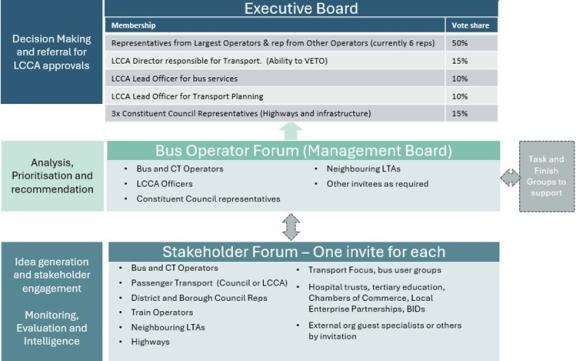
For decision-making purposes, the Enhanced Partnership will be governed by an Executive Board, supported by a Management Board, a structural diagram is shown in Figure J.
Executive Board (EB)
Established by the Enhanced Partnership with the mandate to take decisions using an Enhanced Partnership Scheme Variation mechanism (section 2.6.2) on issues put to them by members and / or the Operator Forum, and other issues identified as being relevant to partnership delivery
Operator Forum (OF)
Includes the Management Board function with a mandate to report to the Board the cost and feasibility of proposed facilities, measures and requirements
In addition, a wider Stakeholder Forum will enable stakeholders in the bus network to bring forward ideas and suggestions about improvements in the public transport network in Lancashire, to be considered by the Management Board and for future work.
The Operator Forum will feed back to the Stakeholder Forum on the outcomes and on what will be taken forward to the Executive Board for future decision making.
A structural diagram is shown next.
Figure J – Lancashire Enhanced Partnership governance structure
2.5.1 Stakeholder Forum
The Enhanced Partnership Stakeholder Forum will provide opportunities for discussing issues of all kinds affecting the Lancashire bus network, consulting with and building consensus across the various stakeholders. The Stakeholder Forum will monitor the achievements of the Partnership against its objectives, and it will monitor delivery against the targets set out in the EP Plan.
Detailed Terms of Reference are set out in Schedule 8.
Membership of the Stakeholder Forum will be voluntary and will comprise (with the exception of Lancashire Combined County Authority) one representative from each of:
- all bus operators running qualifying bus services
- community transport operators
- constituent councils
- all district and borough councils in Lancashire
- Lancashire train operating companies
- neighbouring Local Transport Authorities
- Transport Focus, and any bus user groups in Lancashire as may be constituted
- hospital trusts, tertiary education establishments, Chambers of Commerce and other business / economic organisations within Lancashire
- local organisations representing disabled bus users and other protected characteristics groups.
The Stakeholder Forum may invite other external organisations to join the Stakeholder Forum on an advisory basis for fixed periods to provide specialist expertise.
Stakeholder Forum meetings will take place not less than two times per year, with extra-ordinary meetings held when relevant. Meeting length will vary according to agenda content but ordinarily expected to be one to two hours.
Any business for a Stakeholder Forum meeting, where possible, must be submitted in writing (by post or email to buspartnership@lancashire-cca.gov.uk) at least one week in advance for inclusion on the agenda.
The Stakeholder Forum will be arranged, chaired and minuted by Lancashire Combined County Authority. Agendas and meeting papers (including a copy of minutes and outcomes of decisions taken at the previous OF and EB meetings) will be circulated by LCCA no less than one week in advance of each meeting, and draft minutes circulated no more than two weeks after each meeting. Draft minutes will be approved at the next Stakeholder Forum meeting.
2.5.2 Lancashire Bus Operator Forum
The Lancashire Bus Operator Forum (OF) has three main functions:
- to keep members up to date with and discuss progress with the Bus Service Improvement Plan implementation
- to act as the Management Board for the Enhanced Partnership
- to all members to discuss issues regarding other subjects including fare schemes; the public bus network; bus stops, bus stations and interchanges; bus service information, marketing and publicity; roadworks; and school transport services.
The Operator Forum will be open to all bus operators which operate within and into the authority area:
- 'commercial' bus services including open door school and work services
- public bus services procured by LCCA
- school services procured by the constituent councils
- services operated under section 19 and 22 permits
Representatives from the constituent councils and other neighbouring local transport authorities are able to attend.
Additionally, other parties will be invited where relevant to discuss and answer questions on specific topics.
Management Board Function
The Operator Forum, acting as the EP Management Board, will discuss and develop proposals for the design and implementation of interventions in the form of Facilities, Measures and Requirements, drawing on LCCA’s Bus Service Improvement Plan and receiving ideas, suggestions and proposals from the Stakeholder Forum. It will be responsible for prioritising these interventions against available spend as required. Detailed Terms of Reference are shown at Schedule 8.
The Operator Forum may constitute task and finish groups as it may consider helpful from time to time to provide more in-depth discussions, research particular matters of relevance and to develop business cases to the satisfaction of the Operator Forum members and a level of detail suitable for consideration by the EB. These task and finish groups may be constituted jointly with other local transport authorities.
Votes taken by the Operator Forum will be a majority decision undertaken on a one vote per operator basis.
Meeting arrangements
Operator Forum meetings will take place on a quarterly basis, with provision for additional meetings as required to take decisions which in the opinion of the Chair cannot be deferred to a scheduled meeting, provided that a quorum can be achieved, with not less than one week’s notice being given.
The Operator Forum will be arranged, chaired and minuted by Lancashire Combined County Authority. Agendas and meeting papers will be circulated to all Operator Forum members no less than one week in advance of each meeting date, and draft minutes circulated no more than two weeks after each meeting. Any business for an Operator Forum meeting must be submitted in writing (by post or email to buspartnership@lancashire-cca.gov.uk) in advance for inclusion on the agenda.
2.5.3 Executive Board
The Executive Board (EB) will be the decision-making body of the Enhanced Partnership. Detailed Terms of Reference are shown at Schedule 8. The scope of the EB’s decision-making will be on those matters set out in the Bus Service Improvement Plan and the Enhanced Partnership Plan. Where a decision by Lancashire Combined County Authority is required, for instance on the implementation of bus priority, the EB will have the power to make recommendations and request that such recommendations are formally considered by LCCA.
The EB will be constituted of one representative from all operators of 'commercial' qualifying bus services with 5% or more of the total commercial qualifying mileage within the LCCA area; a representative of the smaller operators of qualifying bus services; and a balancing number of representatives from LCCA and constituent councils. In this instance 'commercial' refers to local bus services either operated without funding from LCCA or under a de-minimis agreement with LCCA, further details are provided in Appendix B. Where operators are part of the same holding company, group, or share persons of significant control (as determined by the authority having regard to the circumstances) they will only be entitled to a single representative between them
The percentage of scheduled qualifying mileage operated 'commercially' by each operator will be collated by LCCA in January of each year covering Q3 of the financial year (October - December). This will determine any changes to the representation for the following financial year. The exception to this is for the initial year of the scheme, in which data will be collected for a four-week period covering 14/09/25 to 11/10/25.
The officer responsible for contracting public bus services at LCCA will act as the de facto bus operator of LCCA's minimum cost and minimum subsidy funded bus services on the Management Board.
Certain decisions of the EB may constitute Enhanced Partnership Scheme Variations pursuant to section 2.6.2 hereof if the requirements therein are met.
EB meetings will require a quorum of three operator representatives (including a small operator representative), the LCCA Director for public transport and two representatives from constituent councils. An operator representative may, if necessary, arrange for an alternate or deputy from the same operator (or another operator in respect of the small operator representative) to participate with voting rights.
Operator representative selection
It is expected that members of the Lancashire Bus Operator Forum with less than 5% of the total commercial qualifying mileage within the LCCA area will select a representative to the EB. The small operator representative will be re-selected on a bi-annual basis, or in response to a representative leaving their company part-way through their term. The term will start on 1 April with elections being held in the final quarter of the proceeding financial year.
Relevant operators will be invited to self-nominate or nominate other willing operators in writing to Lancashire Combined County Authority’s Enhanced Partnership Manager prior to the Q4 Bus Operator Forum. Where there is more than one nominee for the role, bus operators will be given the opportunity to vote by secret ballot undertaken among those present at the Bus Operator Forum for a preferred representative. Voting will be based on one vote per operator (where operators are part of the same holding company or group, they will only be entitled to one vote between them). Where there is a tie, a run-off vote will take place between the leading tied operators.
In the event that a ballot fails to select an operator representative, the default operator objection mechanism set out in the Enhanced Partnerships and Schemes (Objections) Regulations 2018 will be used to determine the views of operators in that category for the purposes of EB votes (in terms of objection or otherwise to the proposals) set out in section 2.6.2.
Role of EB members
The small operator representative will be acting on behalf of all operators in that category, not on behalf of their own company alone. All representatives will be responsible for ensuring attendance at all EB meetings in that year, and ensure they have:
- fully reviewed and understood all meeting papers in advance of attendance
- the required mandate from the operators they represent.
Independent Chair
The terms of reference of the Independent Chair are set out in Schedule 8. The Chair will be appointed by the Operator Forum – the LCCA and all members of the Operator Forum will have the ability to nominate candidates; a vote of election will take place where multiple candidates or vote of approval where there is only one candidate. The Chair's term of office will be two-years, the incumbent Chair is able to stand for re-election.
EB decision-making
Decisions of the EB will be made by way of a vote through a show of hands. The share of the vote for both operators and Lancashire Combined County Authority / constituent councils will be 50%. Figure J shows the share of vote by local authority representative.
Should the members of the EB find that they are in disagreement and after deliberation cannot reach a decision on a particular matter, then they will agree to appoint an independent arbiter who will consider the matter and make the decision on behalf of the EB.
Operators will be entitled to make known their concerns in writing to Lancashire Combined County Authority’s Enhanced Partnership Manager if they object to a particular vote of the EB. LCCA will review the circumstances and consider whether these are such that use of its veto is required as provided for below.
Lancashire Combined County Authority veto
These controls ensure that the voting system:
- does not allow an individual operator to influence the Enhanced Partnership to its own commercial benefit or to harm competitors
- that there is no opportunity for a group of operators to vote in a co-ordinated manner to mutual benefit on a sustained basis; or
- that there is no discrimination between operators; and that actual or potential competition, entry to new services and by new operators, or innovation, is not inhibited.
The Director for Transport at Lancashire Combined County Authority (or nominated other Officer) may, in exceptional circumstances, exercise a veto over EB decisions which it may reasonably believe or suspect as having anti-competitive implications or being otherwise significantly against the public interest.
Meeting observers
Any other Bus Operator, Lancashire Combined County Authority, constituent council or district and borough council representatives will be able to attend the EB meetings as observers but will not have the right to vote. Observers may be invited to make comments or ask questions of the EB at the Chair’s discretion or invited to defer these until the next relevant meeting. They may, at the EB’s discretion, be required to sign an appropriate confidentiality agreement if any discussions or papers submitted include information that is commercial in confidence.
Any person wishing to attend an EB as an observer is required to make a request to attend to Lancashire Combined County Authority’s Enhanced Partnership Manager at least 48 hours prior to the meeting, ether by post or email via buspartnership@lancashire-cca.gov.uk
Meeting arrangements
EB meetings will take place not less than four times per year following the Operator Forum meetings, with provision for additional meetings as required to take decisions which in the opinion of the Chair cannot be deferred to a scheduled meeting, provided that a quorum can be achieved, with not less than one week’s notice being given. Meetings will be arranged and minutes taken by Lancashire Combined County Authority. Meeting length will vary according to agenda content but ordinarily be no more than one hour.
Agendas and meeting papers will be circulated to all EB members no less than one week in advance of each meeting date, and draft minutes circulated no more than two weeks after each meeting. Copies will also be distributed to all Stakeholder and Operator Forum members, as part of the paperwork for the next meeting of these forums, so any issues or concerns can be discussed with the relevant Operator representative, who can then request further agenda items if required prior to the EB meeting. Draft minutes will be approved at the next EB meeting.
Any business for an EB meeting must be submitted in writing (by post or email) in advance for inclusion on the agenda. Any request for inclusion of items on the agenda must include an explanation of how they fulfil the objectives set out in the EP Plan. Such requests may be submitted by the Forum and by the MB as well as members of the EB.
2.5.4 Interaction with Lancashire Combined County Authority
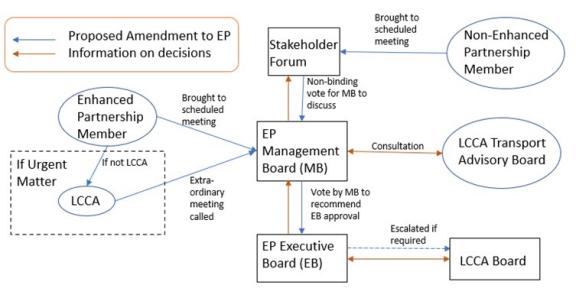
Lancashire Combined County Authority has two levels of governance in relation to Public Transport, i) the LCCA's Transport Advisory Board as a sub-group of the LCCA Board and ii) the Lancashire Combined County Authority Board. Figure K (after section 2.6.3) shows the flow for decision making on non-bespoke changes to the Enhanced Partnership Plan and Scheme and significant changes to the Bus Service Improvement Plan programme.
LCCA Transport Advisory Board
The LCCA Transport Advisory Board meets every two months and provides support and advice to the Lancashire Combined County Authority. A report will be submitted to each Transport Advisory Board meeting outlining developments with the Enhanced Partnership, Bus Service Improvement Plan programme and Key Performance Indicators linked to both the Enhanced Partnership and Bus Service Improvement Plan.
Where there is a general change to the Enhanced Partnership Plan and / or Scheme not covered by the bespoke change mechanism in Section 2.6.2, these will be brought to the Transport Advisory Board for consultation. Where there is a significant change to the Bus Service Improvement Plan programme, the proposed changes will be brought to the Transport Advisory Board prior to submitting to the Lancashire Combined County Authority Board.
Lancashire Combined County Authority Board
The Lancashire Combined County Authority Board meets every two months and is the main decision-making body of the Lancashire Combined County Authority. It is responsible for delivering the devolution deal agreed with government for the benefit of Lancashire residents and businesses.
Where there is a general change to the Enhanced Partnership Plan and / or Scheme not covered by the bespoke change mechanism in Section 2.6.2, these maybe escalated by the Transport Advisory Board to the Lancashire Combined County Authority Board for consultation. Where there is a significant change to the Bus Service Improvement Plan programme, the proposed changes will be brought to the Lancashire Combined County Authority Board for approval.
2.6 Arrangements for reviewing, varying or revoking the Enhanced Partnership Scheme
2.6.1 Review of Enhanced Partnership Scheme
Once the EP Scheme is made, the Facilities, Measures and Requirements contained in Schedules 1 and 2 will be reviewed by the Operator Forum acting as the EP Management Board every twelve months following publication of data on progress towards targets, as required by the BSIP. Lancashire Combined County Authority will initiate each review. The Executive Board will be required to consider this review and decide whether changes to Schedules 1 and 2 are appropriate in response.
The Operator Forum can also decide to review specific elements of the EP Scheme on an ad-hoc basis. Operator Forum members should contact Lancashire Combined County Authority using the following email address buspartnership@lancashire-cca.gov.uk explaining what the issue is and its urgency. Lancashire Combined County Authority will then decide whether to table at the next scheduled meeting or make arrangements for all or the necessary Operator Forum members to meet sooner.
2.6.2 Changes to the Enhanced Partnership Scheme facilities, measures and requirements
Any changes to the facilities, measures or requirements; associated requirements; and governance terms of refence set out in Schedules 1-10 of the EP Scheme; will be considered bespoke changes to the EP Scheme. Any operator of qualifying local services, Lancashire Combined County Authority or constituent council may bring a proposal or proposals to the Operator Forum where it or they will be considered. As described in Section 2.5.2 above, any proposal must be submitted in time for its inclusion in the Operator Forum meeting agenda and must explain how it meets the objectives of the EP Plan.
An Operator Forum vote in favour will lead to the matter being considered by the EB. Lancashire Combined County Authority will then amend the relevant Schedule(s) to this EP Scheme if the EB votes in favour by a simple majority and provided that Lancashire Combined County Authority has not exercised its veto.
If a Small Operator representative for the EB has not been selected, the vote of that category will be determined using the default Operator objection mechanism, specified by the Enhanced Partnership Plans and Schemes (Objections) Regulations 2018.
The EB will also consider when any such changes shall come into force, and / or the linking of the changes (for instance, any Operator Requirements to take effect only once any enabling local authority facilities or measures have been implemented, taking account of the lead time for service registrations should these be required).
As per section 2.3.1 above, any proposal to withdraw or reduce the scope of any bus priority scheme or named passenger interchange or bus station facility requires the written approval of all operators of qualifying services using that scheme at the time the proposal is made.
If Lancashire Combined County Authority considers the matter urgent then it may convene a special meeting of the MB followed by a special meeting of the EB, giving at least 14 days’ prior written notice for the meeting to all Operator Forum members and for the meeting of the EB to consider the proposed variation.
In the event that a number of operators which would trigger the default operator objection mechanism (as set out in the Enhanced Partnerships and Schemes (Objections) Regulations 2018 as may be varied from time to time) raise concerns in writing to a minimum of one subsequent EB meeting about a previous decision of the EB, the decision-making process for Enhanced Partnership Scheme Variations will revert to the default operator objection mechanism contained in those regulations to review that decision and as appropriate for future decision-making purposes.
Appendices
Appendices to the Enhanced Partnership Scheme will only contain background information relevant to the EP Scheme. Appendices can be altered, added or removed by Lancashire Combined County Authority without the need for approval by the Executive Board. The Operator Forum and Executive Board will be notified of any changes to the Appendices of the EP Scheme. A qualifying operator or member of the Executive Board can challenge the alteration, addition or removal of Appendices via the relevant outlet if they feel that it has an impact on the requirements of the Enhanced Partnership upon qualifying operators, constituent council or relevant third party.
2.6.3 Other changes to the Enhanced Partnership Scheme
Any other proposals (i.e. content other than that set out in the Schedules and Appendices) for changes to the EP Scheme will be considered under Section 138L of the Transport Act 2000. The proposer of a variation should demonstrate how this might contribute to achieving the objectives set out in the BSIP, EP Plan and Lancashire Combined County Authority’s current local transport policies. Any such proposals should be in writing and submitted to buspartnership@lancashire-cca.gov.uk
Any operator of qualifying local services, Lancashire Combined County Authority or constituent council may bring a proposal or proposals to the MB where it or they will be considered. If a simple majority of the MB vote in favour, the EB will then consider the proposal or proposals and any accompanying evidence and vote on the change at its next meeting. Lancashire Combined County Authority will then follow the process set out in Section 138L of the Transport Act 2000 and The Enhanced Partnership Plans and Schemes (Objections) Regulations 2018 on behalf of the EB.
Figure K - Enhanced Partnership Scheme amendment process
2.6.4 Revocation of the EP Scheme
Should Lancashire Combined County Authority or any other member of the Operator Forum believe that it is necessary to revoke the Plan or Scheme, then it must express this in writing to the Operator Forum. The Operator Forum will then consider and vote upon the proposal and submit it to the EB which will do the same.
Lancashire Combined County Authority will take into consideration the votes of the Operator Forum and EB in making its own decision whether to revoke the EP Plan or Scheme. It will then follow the process set out at Section 138O of the Transport Act 2000.
2.6.5 Postponement
Should it be necessary to postpone the implementation of any facility, measure or requirement, Lancashire Combined County Authority will follow the procedure at Section 138I of the Transport Act 2000. It must first use reasonable endeavours to seek the views of the Operator Forum and the EB.
2.6.6 Data sharing and commercial confidence
At all times each member of the Stakeholder Forum, Operator Forum and EB will respect data confidentiality, and the Stakeholder Forum, Operator Forum and EB will maintain processes to maintain and respect commercial confidentiality as required. Should any member believe there has been a breach of confidentiality, they should raise this with the Director of Transport or other representative of the LCCA.
2.6.7 Enforcement
Should Lancashire Combined County Authority decide that it wishes to take on the Traffic Commissioner powers, it will follow the procedure to amend the EP Scheme under Section 138L of the Transport Act 2000.