
The Lancashire Combined County Authority Enhance Partnership plan for buses is made in accordance with section 138G(1) of the Transport Act 2000 by Lancashire Combined County Authority.
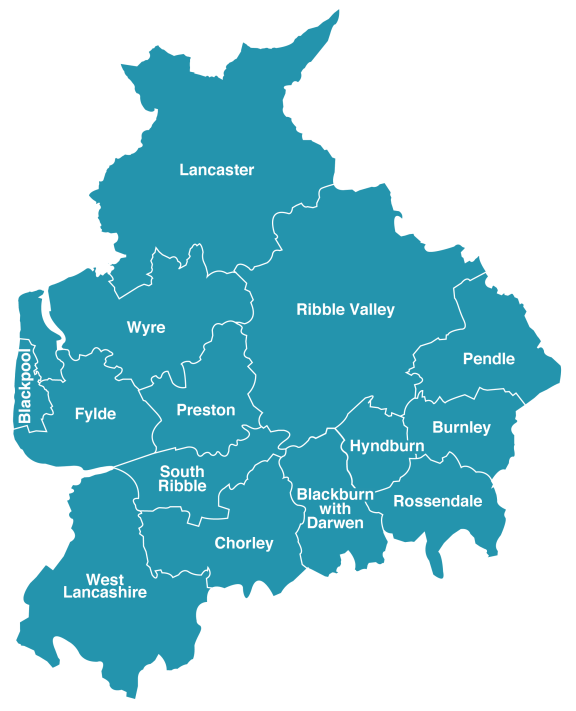
This Enhanced Partnership (EP) covers the entire administrative areas of the Lancashire Combined County Authority as illustrated at Figure A, showing the ‘lower tier’ district council areas within Lancashire County Council and the unitary authorities of Blackburn with Darwen and Blackpool.
The EP Plan will apply during the period of 1 April 2026 to 31 March 2036 and will be reviewed following any update to the Bus Service Improvement Plan (BSIP) or wider structural changes, including but not limited to Local Government Reorganisation.
Lancashire Combined County Authority engages in frequent dialogue with bordering Local Transport Authorities (LTAs) to discuss cross-boundary transport issues. This engagement will continue throughout the EP period to ensure consistency and continuity of bus service provision across local authority boundaries. These authorities being Westmorland and Furness Council (and the emerging Cumbria Combined Authority), Liverpool City Region Combined Authority (Merseytravel), North Yorkshire Combined Authority, Greater Manchester Combined Authority (Transport for Greater Manchester) and West Yorkshire Combined Authority (Metro).
Lancashire County Council as a constituent council of the LCCA already works in partnership with the former Cumbria County councils on the developments associated with the English National Concessionary Travel Scheme, NoWcard; and with all neighbouring authorities on the joint delivery of contracted cross boundary services where costs and development ideas are shared.
Figure A - A Lancashire Combined County Authority administrative area
1.1 EP link to policy objectives
Lancashire County Combined Authority consulted on the 4th Local Transport Plan (LTP4) during October and November 2025. LTP4 sets out four workstreams which each have up to eight policies attached to them. Table 1-1 compares the BSIP ambitions, which the Enhanced Partnership will look to deliver, to the policies set out in LTP4.
Table 1-1 BSIP ambitions and LTP4 policies
| BSIP ambition | LTP4 policies |
|---|---|
| Investment in bus priority schemes to provide faster and more reliable bus journeys, focusing on Superbus routes |
|
| Investment in making bus stops more accessible, with improved shelters and passenger information |
|
| Improving access to employment, health and education facilities by bus |
|
| Providing increased options to travel by bus in more rural areas |
|
| Working closely with developers and employers to ensure the bus service supports our growing economy | Enable the delivery of strategic growth sites |
| Higher bus service frequencies, particularly evenings and weekends |
|
| Better information about local bus services, including regularly updated printed and online information, which has a consistent image |
|
| Roll-out of multi-operator ticketing across the authority area |
|
| Introduce multi-operator tap-on / tap-off fare capping to simplify your travel experience |
|
| Working with our partners to improve the journey experience and ensuring everyone feels safe | Empower everyone to travel safely and securely, wherever they go |
| Cheaper fares during evenings and weekends. Standardised discounted fares to help young people and vulnerable groups |
|
| A Passenger Charter ensuring your voice is heard and the bus network is responsive to the needs of the communities it serves | |
| Investment in zero-emission and low-emission buses to support our net zero ambitions | Accelerate the uptake of electric vehicles |
| Working in partnership with bus operators and neighbouring authorities to improve bus services |
|
1.2 The Lancashire Bus Network and Market
There are five large operators within the LCCA which provide a mixture of commercial and subsidised services, these are:
- Arriva Merseyside – one of the largest operators within the Liverpool City Region, provide a number of cross border services into and through West Lancashire
- Blackpool Transport – the arm's length municipal operator owned by Blackpool Council which additionally operates the Blackpool Tramway
- Preston Bus – owned by Rotala
- Stagecoach Cumbria and Lancashire – now a single subsidiary of Stagecoach covering the LCCA area
- Transdev Blazefield – operations are split between The Blackburn Bus Company and The Burnley Bus Company
Firstbus West Yorkshire is a significant operator within West Yorkshire, however, only operates a single cross-boundary services into the LCCA area. Huyton Travel (now owned by Tower Transit) operates a cross-boundary service jointly funded by Merseytravel and LCCA. North Yorkshire Council's in-house fleet operators a cross-boundary service to Clitheroe through the Hodder Valley.
Transport for Greater Manchester's franchised Bee Network services run into southern parts of the LCCA area, the most significant of these being the trunk Wigan – Coppull – Chorley service 632.
Additionally, there are eleven other operators providing local bus services within the LCCA area.
Table 1-2 outlines the distribution of bus operators by constituent and district council area within the LCCA.
Table 1-2 Public bus operators in the LCCA area (January 2026)
| District / Unitary | Main operators | Other operators |
|---|---|---|
| Blackburn with Darwen | Transdev | Bee Network, Blackburn Private Hire, Moving People, Stagecoach, Travel Assist, Vision Bus |
| Blackpool | Blackpool Transport | Archway Travel, Stagecoach, Transporabus |
| Burnley | Transdev | First West Yorkshire, Moving People, Preston Bus, Vision Bus |
| Chorley | Stagecoach | Bee Network, Holmeswood, Preston Bus, Transdev, Tyrers, Vision Bus |
| Fylde | Blackpool Transport Stagecoach | Archway Travel, Transporabus |
| Hyndburn | Transdev | Pilkingtonbus, Stagecoach, Vision Bus |
| Lancaster | Stagecoach | Lonsdale Buses |
| Pendle | Transdev | Pilkingtonbus, Preston Bus, Stagecoach, Vision Bus |
| Preston | Preston Bus Stagecoach | Archway Travel, Holmeswood, Transdev, Tyrers, Vision Bus |
| Ribble Valley | Stagecoach Transdev | Holmeswood, Pilkingtonbus, Preston Bus, North Yorkshire Council, Vision Bus |
| Rossendale | Transdev | Bee Network, Vision Bus |
| South Ribble | Stagecoach | Holmeswood, Preston Bus, Transdev, Tyrers, Vision Bus |
| West Lancashire | Arriva Merseyside Stagecoach | Bee Network, Charlton MiniCoaches, Holmeswood, Huyton Travel, Preston Bus, Vision Bus |
| Wyre | Blackpool Transport Stagecoach | Archway Travel, Transporabus |
Appendix B outlines the market share by operator.
1.3 Bus service supply
Within the LCCA area several services in the urban areas of Blackburn, Burnley, Preston, Hyndburn, the Fylde Coast and Lancaster provide ‘walk-up’ frequencies of at least 5-6 bph. There are also frequent interurban bus routes which are consistent with the distribution of the population - particularly in east Lancashire. Beyond the urban and interurban services, there are low frequency services to and within the rural north and north-east of the authority area with a strong reliance on local authority funding for many bus services.
Within the LCCA area there is however variable connectivity to major employment areas, with only some sites having a regular weekday daytime service; similarly, service provision during evenings and Sundays is variable, with only main connections provided.
1.4 Bus service infrastructure
Within the LCCA area there are over 10,000 bus stops. Bus stations and interchanges are owned and managed by a variety of councils and third parties; more detail is provided in Appendix C Part 3.
1.5 Bus fares
Bus fares and fare structures vary substantially across the LCCA area. As would be expected for an authority of the size and diversity of LCCA, the complexities of the bus network means that different operators offer different ticketing products. Overlapping and inconsistent fare zones make difficulties in providing clear and comprehensive fares information to users and potential passengers. The Government's £3 adult single fare cap has simplified single and return fares, although Preston Bus withdrew from the scheme in January 2026. Most operators have taken part in BSIP funded £1 evening single fare and £1 Sunday daytime single fare, the latter replacing the original 'Buy Saturday get Sunday Free' day ticket deal in May 2024.
Work is ongoing on a countywide multi-operator ticketing scheme within the LCCA area; however, the Anybus multi-operator ticketing scheme was introduced in Preston through a soft launch, followed by schemes on the Fylde Coast and covering East Lancashire. There are currently inconsistent fare offers for key groups such as students, young people and jobseeker.
1.6 Bus passenger information
A new RealTime Passenger Information System is being rolled out across the LCCA area, led by Lancashire County Council. This has been partly funded by Lancashire County Council's Levelling Up Fund for East Lancashire. Roadside publicity is provided across the LCCA area with work underway to develop a consistent style across the Constituent Councils.
Work is ongoing to develop a central public transport information website for the LCCA area to bring together the information currently provided by the Constituent Councils. The Enhanced Partnership Scheme includes requirements for bus operators who provide information on their websites.
Printed timetables and maps are provided by both the commercial bus operators and constituent councils. Bus Service Improvement Plan funding has helped reintroduce the all-operator network maps.
1.7 Bus fleet
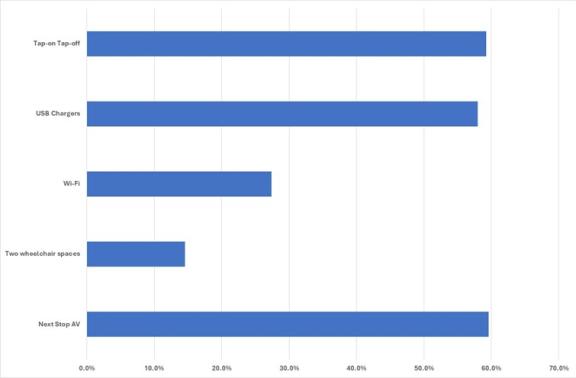
As of October 2025, there are around 700 vehicles based at depots in the Lancashire Combined County Authority area and used on local bus services. Figure B shows the fleet broken down by vehicle type and Figure C by emissions level, whilst Figure D shows the onboard features. This does not include vehicles based at depots outside of the LCCA which operate cross-boundary services.
Figure B - Bus fleet by vehicle type
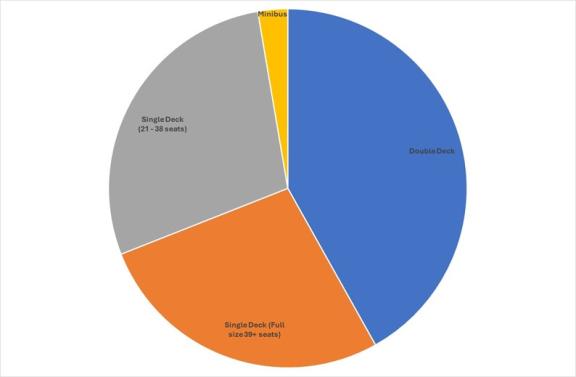
Figure C - Bus fleet by emission levels
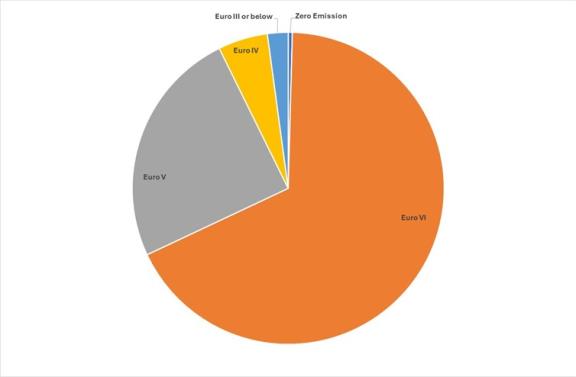
Figure D - Bus fleet by onboard features
1.8 Bus priority measures
Bus lanes and bus gates are located mainly in urban areas at strategic locations, more detail is provided in Appendix C.
1.9 Bus service outcomes
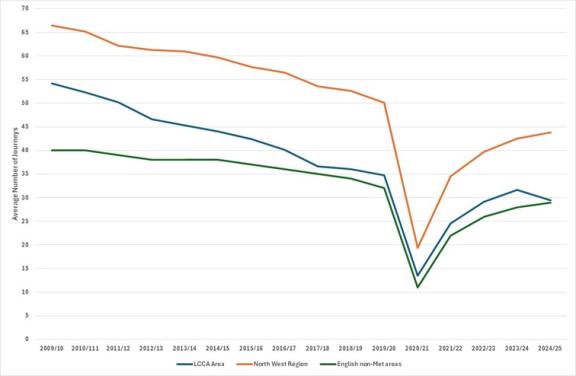
Figure E shows the average number of journeys per year per head of population for the LCCA area using Department for Transport statistics for the LCCA area, the North West region as a whole and English non-Metropolitan authorities. The LCCA area saw the largest drop in journeys per head of population between 2009/10 and 2018/19 at 33.5% against 20.8% in the North West region and 15% in the English non-Met areas. In 2023/24 the LCCA area had the highest recovery rate post-COVID at 87.8% of 2018/19 levels against 83.3% and 85.3% for North West and English non-Mets respectively. However, the LCCA area has seen a decline to 2024/25 against the trend elsewhere meaning a post-COVID recovery level of 81.7% of 2018/19.
Figure E – Average number of bus journeys per year per head of population
1.10 Bus Passenger Experience and Priorities for Improvement
LCCA partakes in the Transport Focus 'Your Bus Journey' bus passenger satisfaction survey. Table 1-3 shows the results from the 2023,2024 and 2025 surveys for the Lancashire Combined County Authority area. This shows the proportion of respondents to the survey who stated that they were either satisfied or very satisfied with each category.
Table 1-3 Transport focus 'Your bus journey' results for LCCA area
| Satisfaction with | 2023 | 2024 | 2025 |
|---|---|---|---|
| Overall journey satisfaction | 80% | 84% | TBC |
| Value for money | 69% | 75% | TBC |
| Bus stop where you caught bus | 77% | 79% | TBC |
| Length of time you had to wait for the bus | 68% | 73% | TBC |
| Punctuality of the bus at stop | 71% | 78% | TBC |
| The bus driver | 86% | 87% | TBC |
2023 data excludes Blackpool Council area.
The Management Board described at Section 2.5.2 of the Enhanced Partnership Scheme will also provide an opportunity for LCCA to elicit the views of those with a stake or interest in bus services, including any bus user groups as may be established, in the performance of the Enhanced Partnership.
The Management Board, supported by the Forums, can monitor the effectiveness of the delivery of facilities, measures and requirements and can liaise with the Enhanced Partnership Executive Board (Section 2.5.3 of the Enhanced Partnership Scheme) regarding priorities for funding and delivery. It has a duty to consider the outputs of any monitoring undertaken by LCCA against the targets set out in this EP Plan and any others agreed for specific initiatives.
1.11 Journey time trends
As part of the Department for Transport's Bus Indicator Pilot, LCCA has been collecting journey time statistics for the 2025/26 financial year although insufficient data has been collected to provide a trend at the time of writing.
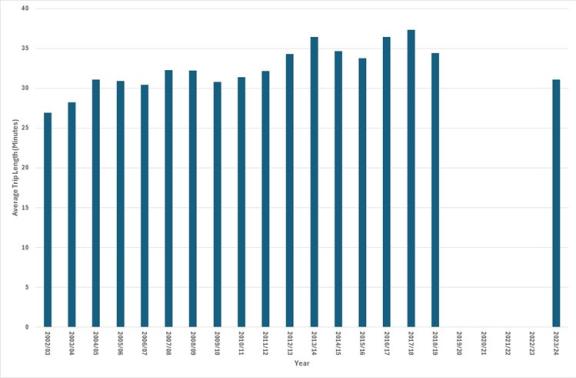
Figures F and G display the National Travel Survey data for local bus travel in the LCCA area from tables 0303e (average hours spent travelling by mode per person per year) and 0303f (average trip duration in minutes by mode) respectively. As can be seen there has been a steady decline in hours spent travelling by bus from 32 hours in 2012/13. Prior to COVID, the average trip length had been on an upward trajectory although it fluctuated year by year.
Figure F – Average hours spent travelling by bus per person per year
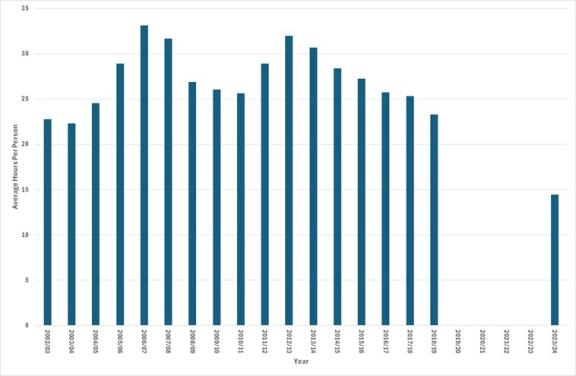
Figure G – Average trip duration by bus per year
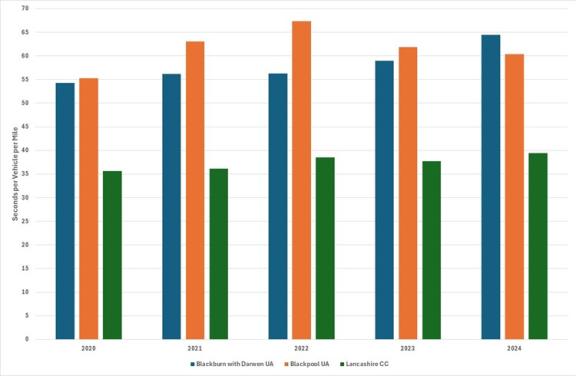
The Department for Transport additionally reports the average delay on local 'A' roads by local authority in England. Figure H below shows the average delay in seconds per vehicle per mile (spvpm) for the three Constituent Council areas between 2020 and 2024. There is no similarity between the three authorities, whilst the Lancashire County Council area has seen a 10.7% increase across the period, Blackburn with Darwen has seen an increase of 18.6% mainly between 2022 and 2024, Blackpool has seen a 10.3% decrease since 2022 after a 21.7% increase.
Figure H – Average delay on local 'A' roads per year by constituent council area
1.12 Objectives of the Enhanced Partnership
The objectives of the Enhanced Partnership are to:
- improve the bus network within the LCCA area by combining the resources and expertise of both the public and private sector
- deliver growth in bus patronage and passenger satisfaction
- deliver the ambitions of the Bus Service Improvement Plan in an affordable and effective manner
Lancashire wants a public transport system - especially buses - that helps everyone stay connected, access essential services, and reach jobs and opportunities. With 1.6 million residents and over 40 million bus journeys a year, buses are central to keeping people moving around the area. The Lancashire Combined County Authority (LCCA) aims to make buses a genuine, attractive alternative to the car.
The vision is built around 10 key principles:
- Frequent – Buses every 15 minutes in major towns/cities and every 30 minutes on key routes.
- Accessible – A bus and community transport network that everyone can use, regardless of need.
- Affordable – Good-value fares for individuals and groups.
- Flexible – Multi-operator tickets available from drivers, online, or via an app.
- Reliable – Buses that turn up on time and run consistently.
- Comprehensive – Routes that link people to jobs, education, health services and leisure.
- Green – Use of low-, ultra-low-, or zero-emission vehicles.
- Attractive – Clean, well-maintained vehicles, stops, and stations.
- Safe – People should feel safe waiting for and using buses at all times.
- Informative – Clear, consistent information on routes, times, fares and disruption.
How these principles translate into action
The vision leads to practical improvements, including:
- faster bus journeys through bus priority measures
- better bus stops with improved accessibility and passenger information
- improved access to jobs, hospitals, schools and colleges
- more travel options for rural communities
- more frequent services, especially evenings and weekends
- better passenger information, both online and printed
- countywide multi-operator ticketing
- tap-on / tap-off fare capping to simplify paying
- cheaper fares in evenings/weekends and discounted fares for young and vulnerable people
- a Passenger Charter to ensure community voices are heard
- investment in low- and zero-emission buses
- partnership working with operators, neighbouring councils, developers and employers
- a focus on making journeys feel safe and improving the overall experience.