
Policy and delivery
We will work towards a transport network that supports a stronger economy, fairer opportunities and a sustainable future through our four LTP policy and delivery workstreams.
| Policy and delivery workstreams | Stronger | Fairer | Sustainable | Cross-cutting |
|---|---|---|---|---|
| 1. Connecting Lancashire: We will unleash our economic potential and deliver our Growth Plan’s Connected Lancashire ambition through better connecting our residents with jobs, businesses with markets, supply chains and customers, and unlocking strategic development across our sub-region | Strongest alignment | Strong alignment | Strong alignment | Alignment |
| 2. Transforming travel choices: We will revolutionise the travel options available for people who live, work and visit Lancashire, broadening travel horizons and providing genuine choices. These measures will increase access to new opportunities, bring benefits to communities and reduce pollution from transport | Strong alignment | Strongest alignment | Strongest alignment | Alignment |
| 3. Safe and vibrant communities: We will help to tackle the root causes of deprivation, poor health and social isolation. We will connect people with new opportunities, regenerate communities and help build healthy living into day-to-day activities | Strong alignment | Strongest alignment | Strong alignment | Alignment |
| 4. Future-ready networks: We will transform Lancashire into a sub-region that is fit for the future. We will integrate new technologies and innovative solutions to ensure our networks are more sustainable, resilient, efficient and ready for growth | Strong alignment | Alignment | Strongest alignment | Strongest alignment |
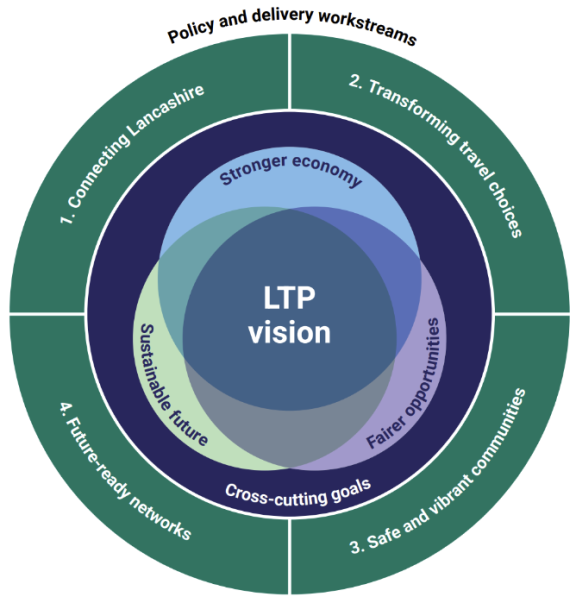
The workstream pages in this document set out our transformative LTP policies. These form the basis for our implementation plans and LTP modal strategies, which in turn set out the schemes we will deliver and our longer-term aspirations.
Spatial priorities
The population of Lancashire is diverse. Each part of the county is unique, with distinct characteristics which are strongly shaped by our physical geography, transport networks and proximity to other areas. Our total population is over 1.5 million, and our people live and work in vastly different areas.
Some areas have relatively dynamic local economies and have attracted highly-skilled people to live, study and work. Other areas are struggling with multiple challenges, such as poor connections, poor quality of place and a weak business base. Many of our more rural areas tend to attract higher-income residents, many of whom commute long distances to towns and cities in Lancashire and beyond.
Every place has its own challenges and opportunities, so a one-size-fits-all approach is not good enough. Different measures and solutions will work in different areas for different communities.
Building on our evidence base, our LTP policies consider four broad area types:
- Central belt: Around three quarters of our population live in the central east-west corridor. This area contains many of our larger settlements as well as suburban and rural areas. The Central Belt does not currently function as a single coherent economic area, but links to four individual north-south corridors.
- Connected south: A mix of towns, villages and rural areas mainly to the south of the Central Belt, with particularly strong cross-border connections with Greater Manchester, Liverpool City Region, and West Yorkshire.
- Rural north: The largely rural area to the north of the Central Belt, including many dispersed communities, as well as the Forest of Bowland National Landscape. This is home to a larger proportion of higher income communities, with an aging population and many who are at risk of transport-related social isolation.
- Bay area: Lancaster and the Morecambe Bay coastal communities, including Morecambe, Heysham, and the Arnside and Silverdale National Landscape. There are strong connections with Barrow and the South Lakes.
Embedding sustainability
Environmental and sustainability considerations will play a key role in everything we deliver. Our design principles ensure that LTP delivery is underpinned by a holistic approach to sustainability.